
The Case for Programmable Legal Documents
Why the future of law is executable documents

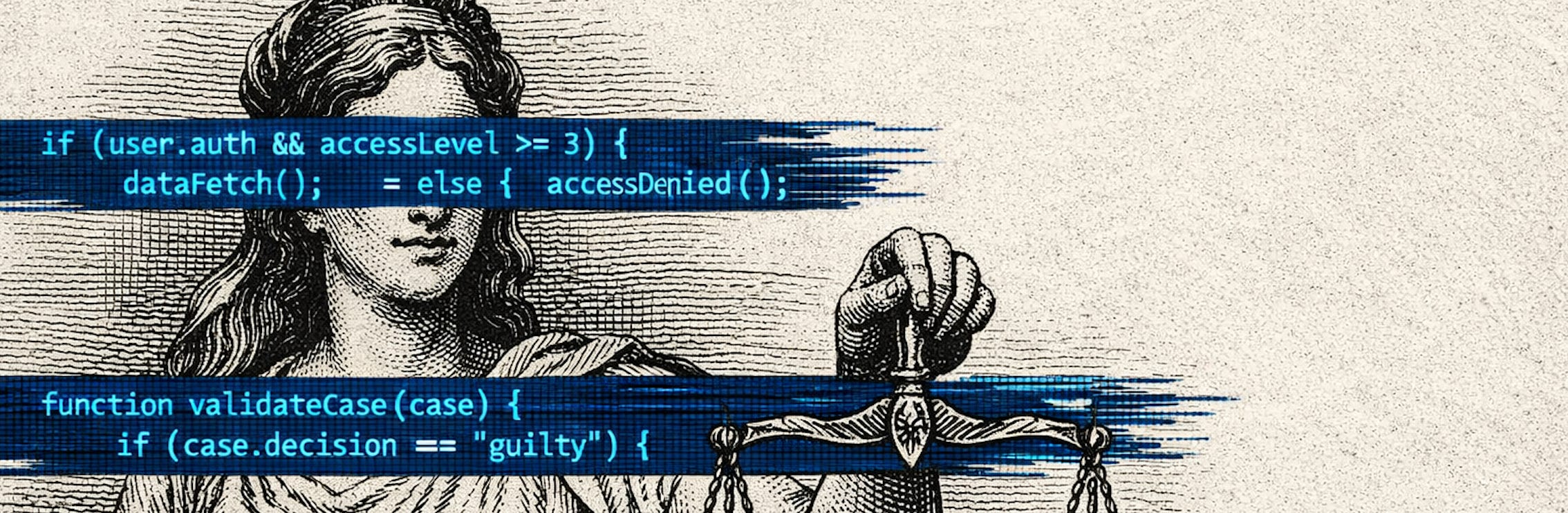
Lawyers do not think of themselves as programmers. This is unfortunate, because much of what they do already resembles programming.
Law and computer science are often portrayed as opposites. One is interpretive and humanistic. The other is formal and mechanical. In practice, both fields are concerned with executing rules under conditions. The difference lies mostly in how those rules are expressed.
Consider how a legal document is created. A lawyer begins with a template. They copy it, rename it, and begin modifying it. If the client is from country A, paragraph X stays. If the company is based in Miami, paragraph Y changes. If the filing uses premium processing, section Z is added. Experienced lawyers do not consciously think about this logic, but it governs every drafting decision.
That is not writing. That is executing an algorithm.
The legal profession has quietly built one of the largest bodies of undocumented logic in the world. It lives inside Word documents, email threads, personal checklists, and institutional memory passed from senior associates to junior ones. When something breaks, the fix is manual and slow. Someone scrolls through the file. Someone edits a clause. Someone forgets a condition. The document is sent anyway.
We pretend these are documents. They are not. They are programs written in prose.
Legal Thinking Is Algorithmic
Conditional logic is everywhere in law. Contracts, petitions, pleadings, and regulations routinely rely on sentences structured as conditional rules.
If this applies, then do that, unless another condition overrides it, except where a statute prohibits it.
In software terms, legal drafting already uses many familiar constructs. Names, dates, jurisdictions, and amounts function as variables. Conditional phrases such as “if,” “provided that,” or “unless” operate as branching logic. Clauses and sections act like reusable functions. Citations and incorporated exhibits resemble imports. When lawyers adapt a precedent for a new case, they are effectively compiling a document from inputs and rules.
A legal document is therefore not just text. It is a decision tree rendered in prose.
The difference between lawyers and programmers is not reasoning style. It is tooling. Programmers have languages designed to express conditions and dependencies explicitly. Lawyers have Word.
The result is predictable. Highly trained professionals spend enormous amounts of time performing tasks that computers handle well: copying text, replacing variables, evaluating conditions, and fixing inconsistencies introduced by manual edits.
Templates were meant to mitigate this. In practice they rarely solve the problem. A template without embedded logic is only a suggestion. As soon as a case diverges from the average scenario, the template fractures. Lawyers fork the document and adapt it locally. From that moment on, no single version remains authoritative. Over time, divergence accumulates and the system decays.
Why Law Never Became Code
The standard explanation is that law is too nuanced to be expressed computationally. It relies on concepts such as reasonableness, fairness, and proportionality that resist precise definition.
There is some truth to this argument, but it does not fully explain the situation.
A more practical reason is historical path dependence. The legal profession standardized around Word and similar text tools in the 1990s. Firms accumulated decades of precedents in document form. Workflows, training practices, and billing models evolved around that interface. Once that ecosystem was established, changing it became difficult.
Another factor is ambiguity tolerance. Legal language often permits flexible interpretation. Computer systems typically demand explicit definitions. Translating law into software forces someone to define boundaries that legal drafting might intentionally leave open.
Today that translation is often performed by engineers or product managers building automation tools. When lawyers are absent from that stage, interpretation moves upstream into system design. The risk is subtle but significant. The operational meaning of legal rules becomes embedded in software architecture rather than expressed directly by legal professionals.
Programmable documents offer a way to correct this imbalance.
Documents Should Execute
Software reduces repetitive work by encoding decisions directly into code. Legal documents never fully adopted that model.
Most document automation systems attempt to compensate by separating logic from text. The document remains a passive template. The logic is moved into questionnaires, workflow diagrams, or configuration panels managed by specialists.
This architecture creates two sources of truth. When the law changes, a lawyer edits the document text but forgets to update the questionnaire. Alternatively, the workflow is modified while the underlying clause remains outdated. Over time the system becomes fragile and difficult to maintain.
In software engineering this pattern is widely recognized as problematic. Logic that is detached from the code it governs becomes opaque and error prone. Documents suffer from the same issue.
The logic should live in the document itself.
If a paragraph applies only when a beneficiary worked in New York, that condition should be attached directly to the paragraph. If a clause is reused across multiple documents, it should exist as a single reference rather than fifty independent copies. If a section must vary depending on inputs, the alternatives should be declared explicitly.
When logic is visible and local to the text it governs, the document becomes easier to maintain and reason about.
Reuse Intelligence, Not Text
Lawyers reuse documents because the reasoning embedded within them has been tested against real cases. The structure works. The logic is reliable.
Current practice, however, treats reuse as duplication. Entire documents are copied and modified. Over time those copies diverge. Changes in one version do not propagate to others. Errors spread quietly across precedent libraries.
Software engineering solved this problem decades ago through modular design and the principle known as “Don’t Repeat Yourself.” Logic is written once and reused across the system. When the underlying rule changes, the update propagates automatically.
Programmable documents apply the same principle to legal drafting. Clauses become reusable components. Conditions become explicit. Dependencies are traceable. Instead of copying text, lawyers reuse validated reasoning.
The result is not merely faster drafting. It is improved correctness.
In legal practice, small errors can have disproportionate consequences. A missing clause may trigger a request for evidence. An outdated paragraph can undermine months of preparation. When logic becomes explicit and inspectable, these risks decrease substantially.
Why This Matters In The Age of AI
Artificial intelligence has reduced the cost of generating text. It has not made documents structurally intelligent.
Large language models can produce paragraphs on demand, but they do not decide where those paragraphs belong, when they apply, or how they interact with other parts of the document. The decision structure remains manual.
Put simply, AI generates text. Lawyers still determine control flow.
At the same time, law firms face mounting pressure. Clients expect faster turnaround. Staffing remains constrained. Regulatory complexity continues to increase. Professionals increasingly expect tools that adapt to their workflow rather than forcing them into rigid systems.
The gap between how legal reasoning operates and how documents are produced is widening.
That gap creates an opportunity.
Documents as Software
The next evolution of legal documentation is not better text generation. It is execution.
A programmable document behaves differently from a traditional one. It responds to structured inputs. It contains explicit conditions. It references reusable components. When compiled, it produces a deterministic output.
Once documents behave like software, several things change.
Complexity becomes manageable because logic is explicit rather than implicit. Firms stop rewriting and begin reusing validated reasoning. Documents evolve into durable assets that improve over time rather than brittle templates that decay.
More importantly, lawyers regain control over automation. Instead of legal rules being translated into opaque systems after drafting is complete, the logic is embedded directly within the document itself. Machines can execute it, while humans can still read and audit it.
This is not simply a better template library. It is not another form builder.
It is a new document format, one aligned with how lawyers already think and reason.
Law has always been programmable. The profession simply never treated its documents that way.